Your knowledge is one of the most valuable things your business owns, yet most experts give it away one conversation at a time. An online course turns that knowledge into a product you build once and sell again and again. Below, we answer the questions business owners ask most often about creating courses and turning expertise into a lasting asset.
What does it mean to turn your expertise into an asset?
It means packaging what you know into something that earns value without requiring your time for every sale. When you consult, coach or train in person, your income is limited by the hours in your calendar. A course captures your methods, frameworks and lessons in a format customers can buy and use on their own schedule.
An asset keeps working after you create it. A well built course can generate revenue, attract new clients and strengthen your reputation for years, long after the filming wraps.
How big is the online learning market?
The online learning market is large and still growing. Statista projects worldwide online education revenue of about $281 billion in 2026, with the United States generating the largest share at roughly $82 billion. Statista also expects the number of online education users to reach 1.2 billion by 2031. (Statista)
Other researchers measure the market differently but point in the same direction. Straits Research estimates the global online education market will grow from $93.3 billion in 2026 to $492.6 billion by 2034, an annual growth rate of about 23 percent. (Straits Research)
The takeaway for business owners is simple: people are already paying to learn online, and demand for practical, skill based training continues to rise.
Why should business owners create online courses?
A course lets you earn from your expertise without trading every dollar for an hour of your time. It also builds credibility, attracts qualified leads and creates a product that keeps selling while you focus on running your business.
- It meets a real and growing demand for skills. The World Economic Forum reports that employers expect 39 percent of workers’ core skills to change by 2030, and 85 percent of surveyed employers plan to prioritize upskilling. (Zenler, citing the World Economic Forum)
- Independent experts are already earning from it. The course platform Zenler reports more than 60,000 creators, more than 20 million students and over $600 million earned by creators through courses, coaching and memberships. (Zenler)
- Specialized knowledge commands higher prices. Platform data from Ruzuku shows a median course price of $110 across all categories, but $531 for coaching and consulting courses and $247 for business and marketing courses. (Zenler, citing Ruzuku)
- It positions you as the authority. A polished course shows prospects that you have a proven method, which makes it easier to win premium clients, speaking invitations and partnerships.
- You own the asset. When you host the course on your own website and build your own email list, you control the pricing, the brand and the customer relationship rather than renting reach from someone else’s platform.
Why is video the best format for an online course?
Video is the format people prefer when they want to learn. According to TechSmith, 83 percent of people prefer video over audio or text for learning, because visuals and sound together make ideas easier to follow and remember. (TechSmith)
The same preference shows up in buying decisions. In Wyzowl’s 2026 survey, 63 percent of consumers said a short video is their preferred way to learn about a product or service, far ahead of text articles at 12 percent. Among marketers, 93 percent said video has helped increase customer understanding of their product or service. (Wyzowl)
Quality matters just as much as format:
- 89 percent of consumers say video quality affects how much they trust a brand. (Wyzowl)
- 57 percent of viewers say clarity is the most important factor in keeping them engaged. (TechSmith)
- 87 percent still prefer a human speaker over an AI presenter, even though most are open to AI support tools. (TechSmith)
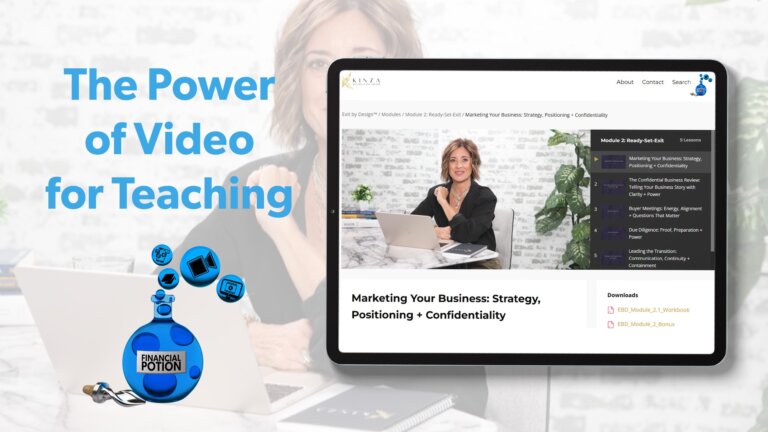
In short, your course is only as strong as the video that delivers it. Clear audio, clean editing and a confident, real presenter build the trust that turns a viewer into a paying student.
How do I get started creating a course?
Start with the result your student wants, not with everything you know. These steps will help you move from idea to launch:
- Define the transformation. Write one sentence describing what a student will be able to do when they finish.
- Choose a specific audience. A course for everyone rarely feels essential to anyone. Name the person, their problem and the outcome they want.
- Validate the idea first. Teach a live workshop or sell a small pilot group before you record everything, so you learn where people actually get stuck. (Zenler)
- Outline the shortest useful path. Remove any lesson that does not move the student toward the promised result.
- Script each lesson. A clear script keeps videos focused, shortens editing time and protects your brand message.
- Keep videos the right length. TechSmith recommends 1 to 6 minutes for quick lessons, 6 to 10 minutes for training videos and 10 to 20 minutes for deeper modules. (TechSmith)
- Produce with professional quality. Invest in good lighting, sound, editing and graphics so your course reflects the value of your expertise.
- Add action and accountability. Give every module a task, worksheet or checkpoint so students apply what they learn.
- Launch, gather feedback and improve. Use student questions and results to refine the course over time.
What are the most common mistakes course creators make?
The biggest mistakes come from treating a course as a pile of information instead of a guided experience. Watch for these:
- Too much content. More videos do not mean more value. Long, unfocused lessons overwhelm students and lower completion.
- Low production quality. About 9 percent of viewers stop watching because a video looks low quality, and poor audio or blurry visuals drive people away. (TechSmith)
- No community or support. Ruzuku found that courses with active community features had a 65.5 percent completion rate, compared with 42.6 percent for courses without them. (Zenler, citing Ruzuku)
- Letting AI replace your voice. AI can speed up outlines and captions, but students pay for your experience, judgment and personality. (Zenler)
- Expecting purely passive income. A course reduces repeated teaching, but it still needs marketing, updates and student support to keep selling.
How can Financial Potion help me create my course?
Financial Potion takes your course from idea to finished, distributed product under one roof. We are a woman owned, full service video marketing company headquartered in Mesa, Arizona, and we have served Valley businesses since 2014.
What is the key takeaway?
Your expertise is already valuable. A professionally produced course turns it into an asset that earns revenue, builds authority and reaches people you could never serve one on one. With online education revenue projected near $281 billion this year and most learners preferring video, there has never been a better time to start. (Statista,TechSmith)
Ready to turn what you know into something you can sell? Book a complimentary strategy session with Financial Potion.